Purpose of Chapter 12 in How to Read Literature Like a Professor
In Arthur Conan Doyle's "The Carmine-Headed League," Sherlock Holmes and Dr. John Watson both notice Jabez Wilson carefully, yet their differing interpretations of the aforementioned details reveal the difference between a "Skilful Reader" and a "Bad Reader." Watson can only describe what he sees; Holmes has the knowledge to interpret what he sees, to depict conclusions, and to solve the mystery.
Understanding literature need no longer exist a mystery -- Thomas Foster'south book will help transform yous from a naive, sometimes confused Watson to an insightful, literary Holmes. Professors and other informed readers see symbols, archetypes, and patterns considering those things are there -- if you have learned to expect for them. As Foster says, you lot learn to recognize the literary conventions the "same fashion you get to Carnegie Hall. Do." (xiv).
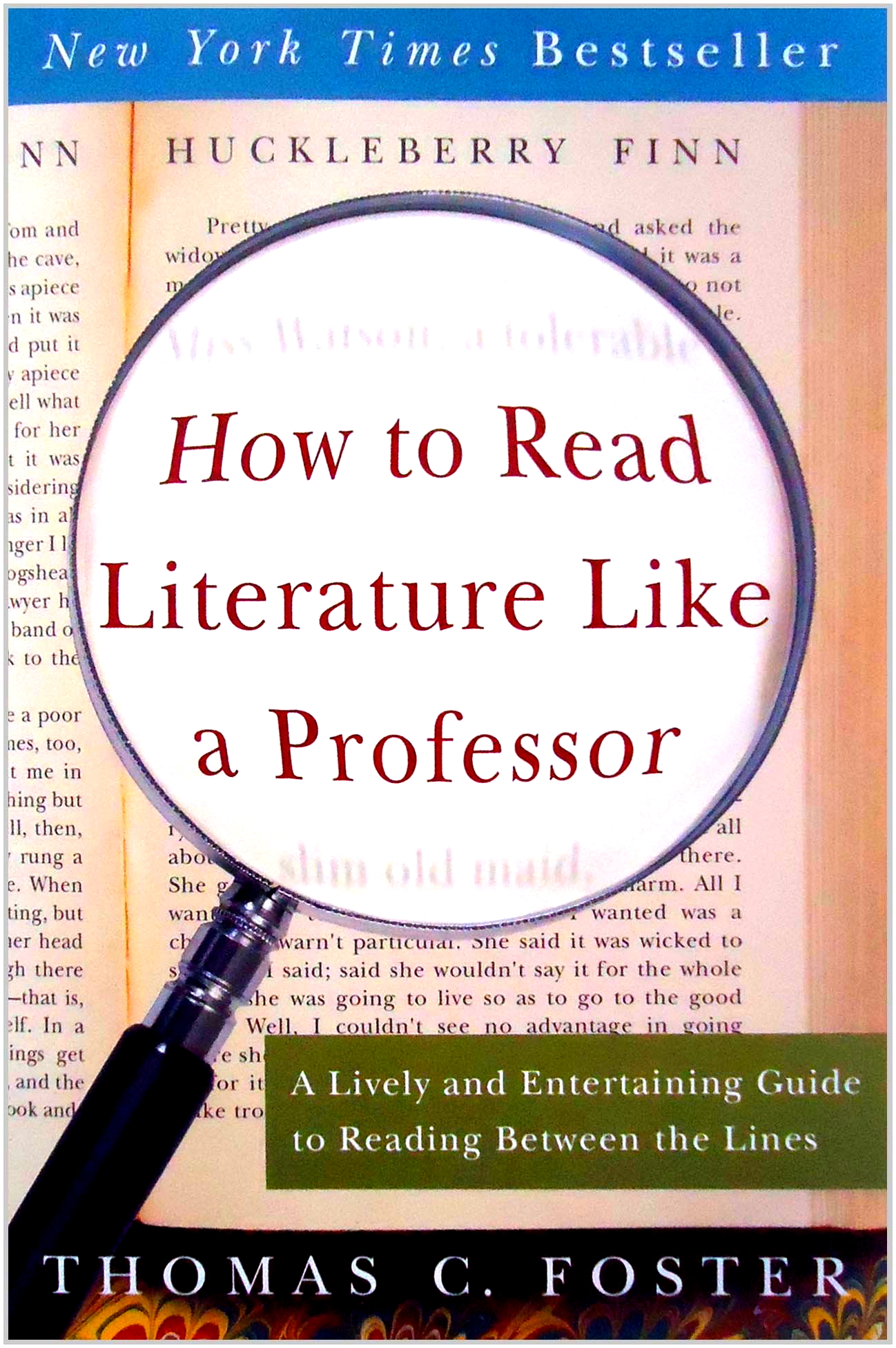 How to Read Literature Like a Professor:
A Lively and Entertaining Guide to Reading Betwixt the Lines
by Thomas C. Foster Total TEXT 
Besides bachelor in a revised second edition, with significant changes. Full TEXT
Notation to teachers: LitCharts has affiliate handouts and a Teacher Guide. Harper Collins Teacher Guide presents challenging belittling writing and is correlated with Common Cadre. PowerPoint version of Marti Nelson'southward notes (sent to me past an unnamed contributor). Literary Guideposts from Oak Park High School combines notes and questions (by Enoch and Rohlfs). Thomas Foster Meets Kate Chopin requires that students apply Foster to "The Story of an Hr" (by Rebecca Mooring).
Teachers Pay Teachers offers workheets and quizzes on the book. In particular, AP Lit and More, Gina Kortuem'southward shop materials are adjusted for the 2019 CED and could largely stand without the text through the daily Bellringers. Only in time for distance learning, Kortuem has added a Hyperdoc Unit that works in Google Slides, consummate with bellringers, lesson principles, application, boosted information, and a diverse written responses.
Note to students: These short writing assignments will let you practice your literary assay and they will help me go to know you lot and your literary tastes. Whenever I ask for an example from literature, you may use short stories, novels, plays, or films (Yes, moving-picture show is a literary genre). If your literary repertoire is thin and undeveloped, utilise the Appendix to jog your memory or to select additional works to explore. At the very to the lowest degree, lookout some of the "Movies to Read" that are listed on pages 293-294. Please annotation that your responses should be paragraphs -- non pages!
Even though this is analytical writing, yous may utilise "I" if you deem it important to practice and then; call up, however, that well-nigh uses of "I" are only padding. For example, "I call up the wolf is the nearly important character in 'Little Cerise Ridinghood'" is padded. As you compose each written response, re-phrase the prompt as part of your answer. In other words, I should exist able to tell which question you are answering without referring dorsum to the prompts.
Concerning mechanics, pay special attending to pronouns. Make antecedents articulate. Say Foster start; not "he." Remember to capitalize and punctuate titles properly for each genre.
Assignments below are for the first edition. They are re-listed, with appropriate additions, for the second edition on its page. You may download a set of Notes (by Marti Nelson) on this book to help yous in your analysis. Too a copy of these assignments (Word or as .PDF) and a Grading Checklist (Give-and-take or every bit .PDF).
Introduction: How'd He Exercise That?
How do memory, symbol, and pattern bear upon the reading of literature? How does the recognition of patterns make it easier to read complicated literature? Discuss a time when your appreciation of a literary piece of work was enhanced by agreement symbol or pattern.
Chapter 1 -- Every Trip Is a Quest (Except When Information technology's Not)
List the five aspects of the QUEST and then apply them to something you have read (or viewed) in the class used on pages 3-5.
Chapter two -- Dainty to Eat with You lot: Acts of Communion
Choose a meal from a literary piece of work and utilize the ideas of Chapter two to this literary delineation.
Chapter three: --Nice to Eat You: Acts of Vampires
What are the essentials of the Vampire story? Utilize this to a literary work you lot accept read or viewed.
Chapter 4 -- If It'southward Foursquare, It's a Sonnet
Select three sonnets and prove which form they are. Discuss how their content reflects the form. (Submit copies of the sonnets, marked to bear witness your assay).
Chapter five --Now, Where Take I Seen Her Before?
Ascertain intertextuality. Discuss iii examples that have helped yous in reading specific works.
Chapter 6 -- When in Dubiousness, Information technology's from Shakespeare...
Discuss a piece of work that yous are familiar with that alludes to or reflects Shakespeare. Show how the author uses this connection thematically. Read pages 44-46 carefully. In these pages, Foster shows how Fugard reflects Shakespeare through both plot and theme. In your discussion, focus on theme.
Chapter 7 -- ...Or the Bible
Read "Araby" (available here). Hash out Biblical allusions that Foster does non mention. Look at the example of the "two swell jars." Exist artistic and imaginative in these connections.
Affiliate 8 -- Hanseldee and Greteldum
Think of a piece of work of literature (including film) that reflects a fairy tale. Discuss the parallels. Does it create irony or deepen appreciation?
Chapter nine -- It's Greek to Me
Write a gratuitous verse poem derived or inspired by characters or situations from Greek mythology. Exist prepared to share your verse form with the class. Greek mythology bachelor online.
Chapter x -- It's More Than Just Rain or Snow
Discuss the importance of weather in a specific literary work, non in terms of plot.
Interlude -- Does He Hateful That
Chapter 11 --...More Than It's Gonna Hurt You: Concerning Violence
Present examples of the two kinds of violence institute in literature (including motion-picture show). Show how the effects are dissimilar.
Chapter 12 -- Is That a Symbol?
Use the process described on page 106 and investigate the symbolism of the contend in "Araby." (Mangan's sister stands behind information technology.)
Chapter 13 -- It's All Political
Assume that Foster is right and "it is all political." Use his criteria to show that i of the major works assigned in a previous year is political.
Chapter xiv -- Yes, She's a Christ Figure, Too
Apply the criteria on page 119 to a major grapheme in a significant literary work. Try to choose a character that volition have many matches. This is a peculiarly apt tool for analyzing film -- for case, Star Wars, Absurd Hand Luke, Excalibur, Malcolm X, Braveheart, Spartacus, Gladiator and Ben-Hur.
Affiliate 15 -- Flights of Fancy
Select a literary piece of work in which flying signifies escape or freedom. Explicate in item.
Affiliate 16 -- It's All About Sex activity...
Chapter 17 -- ...Except the Sex
OK ..the sex capacity. The key idea from this affiliate is that "scenes in which sexual practice is coded rather than explicit can work at multiple levels and sometimes be more than intense that literal depictions" (141). In other words, sexual practice is frequently suggested with much more than art and effort than information technology is described, and, if the author is doing his chore, information technology reflects and creates theme or character. Cull a novel or movie in which sex is suggested, but not described, and discuss how the human relationship is suggested and how this implication affects the theme or develops characterization.
Affiliate 18 -- If She Comes Upwards, Information technology'south Baptism
Think of a "baptism scene" from a significant literary piece of work. How was the character different after the experience? Discuss.
Chapter 19 -- Geography Matters...
Discuss at to the lowest degree iv different aspects of a specific literary piece of work that Foster would classify under "geography."
Chapter twenty -- ...So Does Season
Detect a poem that mentions a specific flavor. So discuss how the poet uses the season in a meaningful, traditional, or unusual way. (Submit a copy of the verse form with your assay.)
Interlude -- One Story
Write your own definition for archetype. Then place an archetypal story and apply it to a literary piece of work with which you are familiar.
Chapter 21 -- Marked for Greatness
Why exercise writers give characters in literature deformities? Figure out Harry Potter'due south scar. If y'all aren't familiar with Harry Potter, select another grapheme with a physical imperfection and analyze its implications for characterization.
Chapter 22 -- He'southward Blind for a Reason, Yous Know
If it is difficult to write a story with a blind character, why might an author include one? Explain what Foster
calls the "Indiana Jones Principle".
Chapter 23 -- Information technology's Never Just Heart Disease...
Chapter 24 -- ...And Rarely Simply Affliction
Why does Foster consider heart disease the best, most lyrical, nearly perfectly metaphorical illness? Recall ii characters who died of a disease in a literary work. Consider how these deaths reflect the "principles governing the use of disease in literature" (215-217). Discuss the effectiveness of the expiry as related to plot, theme, or symbolism.
Affiliate 25 -- Don't Read with Your Eyes
After reading Affiliate 25, choose a scene or episode from a novel, play or ballsy written before the twentieth century. Contrast how it could be viewed by a reader from the twenty-get-go century with how it might be viewed by a contemporary reader. Focus on specific assumptions that the author makes, assumptions that would non make it in this century.
Chapter 26 -- Is He Serious? And Other Ironies
Select an ironic literary work and explain the multivocal nature of the irony in the work.
Affiliate 27 -- A Test Case
Read "The Garden Party" by Katherine Mansfield, the curt story starting on page 245. Complete the practice on pages 265-266, following the directions exactly. Then compare your writing with the three examples. How did yous do? What does the essay that follows comparing Laura with Persephone add to your appreciation of Mansfield'due south story?
Envoi
Choose a motif not discussed in this volume (every bit the horse reference on page 280) and note its appearance in three or four unlike works. What does this idea seem to signify?
Adapted from Assignments originally developed by Donna Anglin. Notes by Marti Nelson.
Purpose of Chapter 12 in How to Read Literature Like a Professor
Source: https://mseffie.com/assignments/professor/professor.html
0 Response to "Purpose of Chapter 12 in How to Read Literature Like a Professor"
Postar um comentário